·
Solo to Tonga Under a Crab Claw Rig
Some sailing friendships begin at the yacht club bar. Mine with Dominic Tarr began with a lifejacket waved in the air, a lucky coincidence, and an evening sail on my Farr Platu 25. Not long after, Dominic set off alone across the South Pacific to Tonga, under a sail most people would only ever see in a museum. This is the story of both.
A wave across the water
I was out on my Platu 25 when I noticed a little dinghy sailing a long way off. I didn't know who was aboard, but it looked like fun. So I did what any curious sailor might do: I grabbed my lifejacket and waved it over my head.
My plan was simple. If they came over, maybe I could hop in and have a go sailing the dinghy with them. Then I watched the little boat bear away, point its bow straight at me, and come running downwind towards my stern.
As it got closer, the sailor looked at me, then looked again. He recognised me from my YouTube videos. It was Dominic Tarr. We had never met in person, but we already knew each other: for a while we had been commenting on each other's sailing videos. Out of all the boats on all the water that day, the one I happened to wave at belonged to an online sailing friend.
An evening on the Platu
We laughed about the coincidence. Then Dominic asked if we could take my Farr Platu 25 out sailing that evening. I said sure, why not.
So that's what we did. Two people who had only ever swapped comments under YouTube videos ended up sharing a cockpit, trimming sails and talking boats as the evening wore on. It's one of my favourite things about sailing in New Zealand: the community is small, friendly, and full of happy accidents.
Meet Dominic Tarr
If you've never come across Dominic, he's one of the most interesting people I've met on the water. Before sailing took over his life, he was a well-known name in software. He was part of the early Node.js scene and founded Secure Scuttlebutt, a peer-to-peer social network. Today his profile simply says he's retired from tech.
He brings the same tinkering mindset to boats. He has lived aboard in New Zealand for years, built beach-launched sailing outriggers, and restored a Wharram Pahi 31 catamaran he found abandoned by the side of the road. In late 2024 he sailed his small home-built proa from Whangārei to the Lagoon Bay Raid. He documents it all on his YouTube channel, Dominic Tarr Sailing.
Alone to Tonga
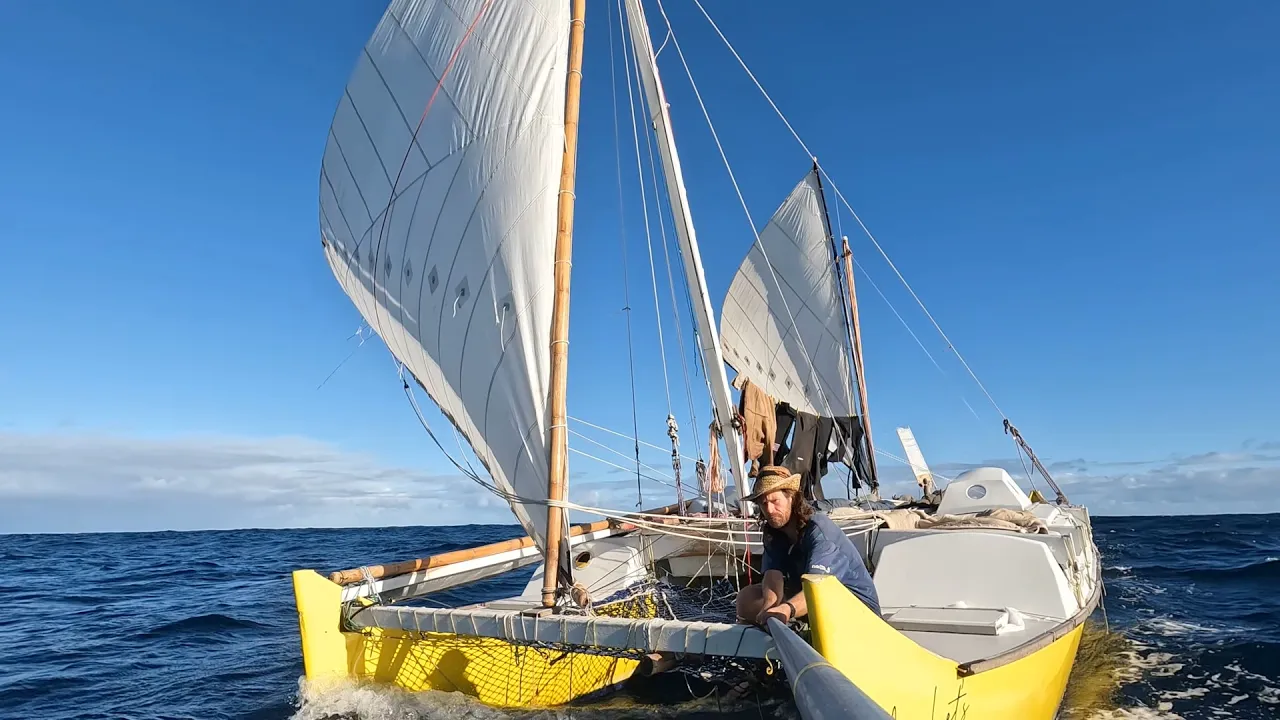
Dominic's latest video, NZ to Tonga With My Experimental Rig, follows him on a 1,116-nautical-mile solo passage from New Zealand to Tonga, in a catamaran he rescued from a derelict state and rebuilt himself, under a rig of his own design. Most sailors would test a new idea on a calm afternoon in the harbour. Dominic tested his for 500 miles around New Zealand, then pointed it at the open ocean. The whole trip was a proof of concept: could a cheap, simple, traditional-style rig carry one person safely across the South Pacific?
The crab claw rig, and how it works
The heart of this voyage is the sail. Most modern yachts use a Bermuda rig: a tall mast standing straight up, a triangular sail hoisted up it, and a boom along the bottom. Dominic chose something far older. His catamaran carries a crab claw rig, inspired by the sails Pacific voyagers used to cross huge stretches of ocean long before Europeans arrived.
A crab claw sail is a triangle of cloth stretched between two long spars, called yards. The two yards meet at a point down low, near the front of the boat, and spread apart as they rise into a wide V. Seen from the side, the sail looks like the open pincer of a crab, which is where the name comes from. On Dominic's boat, at least one of those yards is a length of bamboo.
The shape is cleverer than it looks. The wide, curved top of the sail behaves a little like a delta wing on an aircraft. As wind flows over its edges it forms swirling vortices that add extra lift. That makes a crab claw very powerful for its size, especially when the wind is coming from the side or from behind. A downwind passage from New Zealand north to the tropics is exactly where it should shine.
It also suits a home builder. The rig is low-tech and cheap, built from simple materials. Because the sail's load is spread through the yards rather than concentrated at the top of one tall mast, the forces on the boat are gentler. The trade-off is that no one really knows how a home-built crab claw holds up across 1,100 miles of open ocean. That was exactly what Dominic set out to find out.
Setting off
Dominic didn't just throw off the lines and hope. Before the big trip he put the boat and rig through 500 miles of sailing around New Zealand, shaking out problems close to home. Then, on a Monday, he left New Zealand behind and headed north, alone, with 1,116 nautical miles of ocean between him and Tonga.
Early in the video he shows off the two things that make a solo passage like this possible.
The first is his home-made servo-pendulum self-steering. When you sail alone for nearly two weeks you can't sit at the tiller the whole time; you have to sleep, eat and fix things. A servo-pendulum system steers for you, using only the wind and the water. A small wind vane at the back of the boat is set at an angle to the wind. If the boat drifts off course, the wind hits the vane differently and tips it over. That twists a narrow blade, or fin, hanging in the water behind the boat. The water rushing past pushes the twisted fin hard to one side, and that swinging motion pulls on lines attached to the tiller, nudging the boat back on course. There's no electricity and no motor. The boat's own speed powers its steering.
The second is how he has set up the controls. Dominic can run the boat mostly from the hatch, with the lines he needs led to where he can reach them without climbing out. For a solo sailor that is a big deal. The deck is the most dangerous place on a small boat at sea, and if you go overboard alone, there is no one to turn around and pick you up. The less time spent out there, the better.
The first problems
The ocean didn't take long to start testing the rig. The first trouble was a chafed halyard. The halyard is the line that hoists the sail and holds it up. Chafe is what happens when a rope rubs against something, again and again, with every roll of the boat. Out at sea that rubbing never stops, and slowly the rope wears through. If a halyard parts, the whole sail comes crashing down. Dominic caught it and re-rigged while still underway, working on a moving boat in the middle of the ocean.
Not long after, he was splicing stays. Stays are the lines that hold the mast up and keep it from falling forward, backward or sideways. A splice joins or finishes a rope by unlaying its strands and weaving them back into itself. Done well, a splice keeps most of the rope's strength, far more than any knot. When the rope in question is holding up your mast a thousand miles from land, that matters.
Then the wind simply disappeared. Dominic found himself becalmed: no wind, the boat going nowhere, the sail flapping uselessly as the swell rolled under him. Anyone who has sailed offshore knows calms can be more frustrating than storms. You can't fix a calm with rope and skill. All you can do is wait.
Mid-ocean: rest, fire and a broken yard
Sailing alone means managing your own energy as carefully as the boat. When Dominic needed a break, he hove to. Heaving-to is an old seamanship trick. You set the sail and the rudder so they work against each other: the sail tries to drive the boat forward while the rudder tries to turn it into the wind. The two cancel out, and the boat almost stops, sitting quietly and drifting slowly sideways. The violent motion eases, and a tired sailor gets a chance to sleep, cook a meal, or calmly sort out a problem.
And there were more problems to sort out. Some of his lines were getting damaged, and Dominic repaired them with fire. Modern ropes are made from synthetic fibres that melt when heated. When a rope end frays or a damaged section starts to unravel, a flame melts the loose fibres and fuses them together. It's a simple fix every sailor learns, done with nothing more than a lighter.
Then came the biggest setback so far: the bamboo yard broke. On a crab claw rig, the yards are what hold the sail's shape. Lose one and you lose your engine. Out there, with no hardware shop for a thousand miles, Dominic repaired it at sea and got the rig flying again. It's the kind of moment that shows whether an experimental rig is truly practical. A good offshore rig doesn't need to be unbreakable; it needs to be fixable with what you have on board.
Steering trouble, squalls and 16 knots
With the yard fixed, the self-steering started acting up. The fin, the blade that hangs in the water and does the actual work of steering, kept giving him trouble, and not just once. For a solo sailor this is about as serious as it gets short of a breakage. If the self-steering fails, you either steer by hand around the clock or you stop the boat. Dominic kept nursing it back into service.
The second half of the passage brought very different weather from the early calms. Heavy squalls rolled through: dark clouds that arrive fast, bringing sudden strong gusts and rain, then pass just as quickly. The seas built and the ride got rough.
Then came the wildest part of the trip. With big waves rolling up from behind, the catamaran began to surf, racing down their faces at up to 16 knots. That's thrilling on a small home-built boat, and genuinely dangerous. Catamarans are light and fast, and if one surfs too fast down a wave, its bows can bury into the back of the wave ahead. The boat stops dead while the stern keeps going, and it can flip end over end. Sailors call this pitchpoling.
Dominic's answer was to trail a long warp: a heavy rope streamed out behind the boat. Dragging through the water, the warp acts like a brake. It holds the speed down to something safe and keeps the stern pointed into the waves, so the boat runs straight instead of slewing sideways. It's one of the oldest heavy-weather tactics there is, and it worked.
Landfall in Tonga
After 12 days and 23 hours alone at sea, Dominic sighted Tonga. Across 1,116 nautical miles, that's an average of about 3.6 knots, or roughly 86 miles a day. And that's including the calms, the stops to rest and every repair along the way.
Arriving in a new country by yacht isn't as simple as tying up and walking ashore. Every boat has to clear customs, immigration and biosecurity first, and until then the crew must stay aboard. So Dominic anchored in the lee of Pangaimotu Island, the sheltered side, out of the wind and swell, and waited for his check-in.
It's a quiet ending to a dramatic passage, but a satisfying one. The derelict catamaran he rebuilt and the crab claw rig he designed and repaired along the way had done what he set out to prove. They had carried him safely across an ocean.
What I took from it
Watching this video after sailing with Dominic on the Platu, I came away with real respect for how he goes about things. He doesn't wait for the perfect boat or the perfect rig. He takes a wreck most people would walk past and an ancient Pacific sail design, tests them properly, and then trusts his skills to handle whatever breaks. When the halyard chafed, the yard snapped and the self-steering played up, he didn't turn back. He fixed it with rope, fire and patience, and kept sailing.
And he shares all of it openly, the failures as much as the wins, so the rest of us can learn.
It's also a good reminder of how that friendship started. If you see a boat out on the water, give it a wave. You never know who's aboard, or where it might lead.
Watch the full voyage
You can watch Dominic's video, NZ to Tonga With My Experimental Rig, and follow his next adventure on his YouTube channel.